
Our Mission is to Harness the Science of Writing
Brought to you by Vantage Learning, the Vantage Science of Writing Hub is dedicated to advancing student literacy through rigorous research and classroom practices that are evidence-based, technology-aided, and innovative.
Our mission is simple: to empower educators, researchers, and leaders with accessible knowledge, collaborative spaces, and evidence-based, practical tools that transform teaching and learning.
Our vision is to reignite the power of writing.
Literacy encompasses research in a multitude of subject areas, not the least of which include reading, writing, math, science, and information. While all are important aspects of being literate in the modern world, we choose to intensively focus on writing because the current state of writing is, itself, in a state needing intensive care.
What is the State of Literacy: A Translational Crisis

Diagnosis: Critical. Prognosis: Guarded.
Accelerating literacy outcomes remains a national priority, yet all indicators trend toward flat or declined growth. Despite decades of testing and research, we have yet to translate findings into effective, scalable interventions that reach every learner.
In the 2024 National Association of Educational Progress (NAEP) reading assessment, one in three (33% of) 8th graders and two in five (40% of) 4th graders failed to meet the Basic benchmark–the highest rate of underperformance in three decades. These students cannot reliably identify fundamental elements in a text–such as the order of events, character traits, and main ideas–a sign of systemic failure at the cellular level of literacy. That failure is further underscored by the fact that 70% of 8th graders and 65% of 4th graders do not demonstrate the skills or knowledge required to be proficient readers.
Missing Metrics. Incomplete Diagnosis.
Since no writing assessment was conducted in 2024, we are left to extrapolate—bridging from prior writing data and current reading trends. What we do know is that reading and writing are interdependent systems: when one fails, the other declines in tandem.
What Does Past Writing Performance Tell Us?
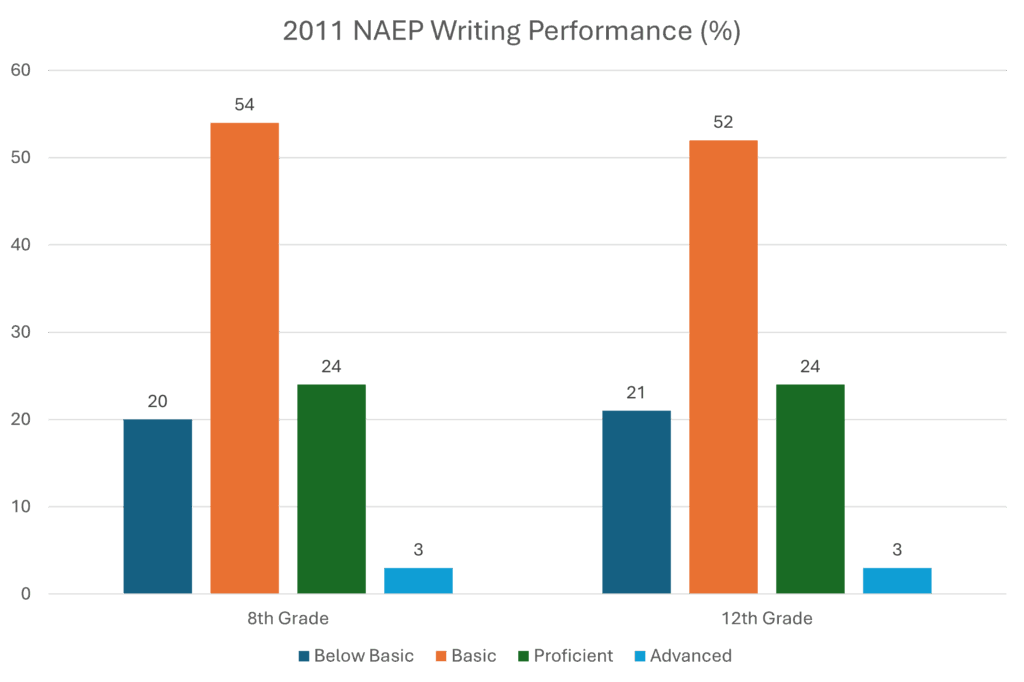
According to results from the NAEP 2011 writing assessment of 8th and 12th grade students, around three out of four students, did not have skills/knowledge sufficient to communicate clearly! Only the rare few (< 3%) demonstrated an Advanced (superior) proficiency level, and only one in four students (~3%) achieved Proficiency (skills/knowledge sufficient to communicate clearly).
Where do these results leave students, teachers, schools, and districts?
How do we know where students stand in writing proficiency today? The absence of writing data is a red-flag warning: we must measure writing achievement accurately and consistently if we want to improve it. If results from the 2024 NAEP reading assessment are any indication of writing progress, we have every reason to believe there has been a decline in writing proficiency, as well.
Without updated national results in the last decade and a half, educators lack a clear, current picture of how students are faring, even as literacy challenges grow more urgent. This gap leaves schools without current nationally comparative benchmarks at a time when recent NAEP data show sharp declines in reading and math proficiency.
From Observation to Intervention.
It is time to move literacy research and instruction from a descriptive model to a translational one in which findings inform actionable, evidence-based interventions.
Doing nothing is not an option when there are solutions!
To carry out our mission, we intentionally focus on the critical gap of improving the current state of writing.
Our first step is to examine the body of research supporting how humans learn to write:
- The neuroscience that shows how a healthy brain learns to read and write,
- The strands, or knowledge and skills, of learning to speak, read, and write that work together to form what we call The Literacy Rope, and
- The intentional application of evidence-based teaching and learning strategies for developing proficient writers.
Our second step is to consider ways to measure the state of student writing.
Our third step is to support and promote the most effective, evidence-based practices to address challenges in writing and in writing instruction.
Our fourth step is to investigate the need for Knowledge and Practice Standards for Teachers of Writing.

The Neuroscience in Reading, Writing, and Language Acquisition
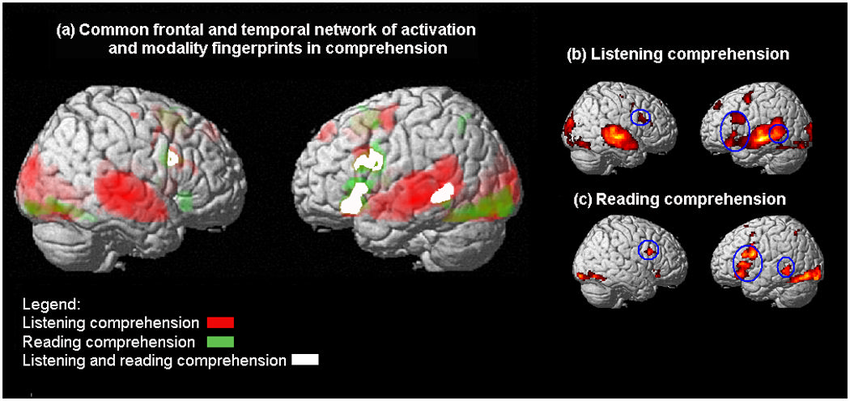
What happens in the brain when trying to comprehend what one hears versus what one reads?
Learning to speak begins with listening to the sounds a caretaker makes when speaking. The learner decodes sounds and mimics them before gaining some understanding of what those sounds (connected phonemes) mean. These actions take place during the listening and speaking phase of language acquisition. The skills one develops when acquiring spoken language activate some, but not all, parts of the brain–that is, they are amodal.
The regions of the brain one uses to comprehend what one hears have some crossover with the regions of the brain one uses to comprehend what one reads. This concept is observed in the results of brain imagery studies that map brain activation under each condition. The takeaway from the study is that a few of the same pathways activate when trying to comprehend by listening and when trying to comprehend by reading. This finding demonstrates the brain’s ability to perform similar functions (comprehension) under disparate conditions!
From Observation to Intervention.
It is time to move literacy research and instruction from a descriptive model to a translational one in which findings inform actionable, evidence-based interventions.
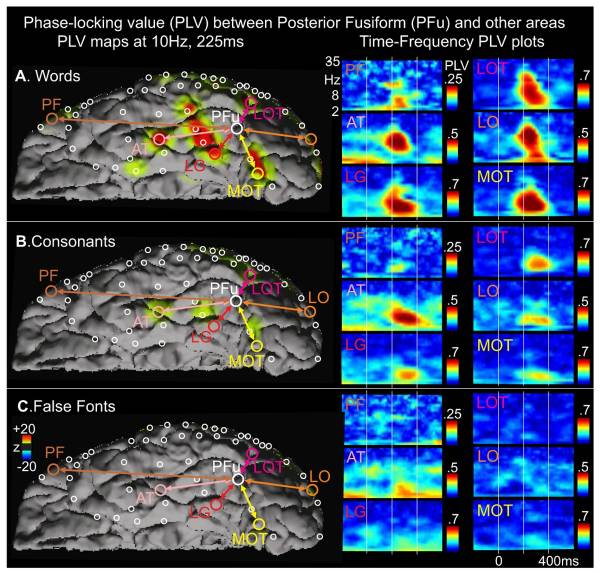
The brain is more engaged when reading words than when recognizing letters!
Functional Magnetic Resonance Imaging (fMRI) shows that there is greater activity (the red and yellow spots in the two right columns of images) in the brain when reading words than when recognizing letters (specifically, consonants), and the brain is least busy when seeing false fonts (letter-like figures arranged in a string resembling a word). These findings illustrate that as reading development progresses from nothing to letters to words, brain activity increases and forms more extensive neuronal pathways–that is, connections between neurons.
The brain is more engaged when reading words than when recognizing letters!
When reading a word, the brain reacts with measurable activity in specific areas, forming links of nerve fibers, which get stronger and thicker with repetition of activity along these neural pathways. Myelin then insulates the pathways to protect them. These insulated neural pathways are what we refer to as “white matter.” The more white matter, the more automatic reading becomes.
From Thesen Lab located at https://med.nyu.edu/thesenlab/research-0/research-functional-magnetic-resonance-imaging-fmri/)
Writing activates a large number of areas of the brain!
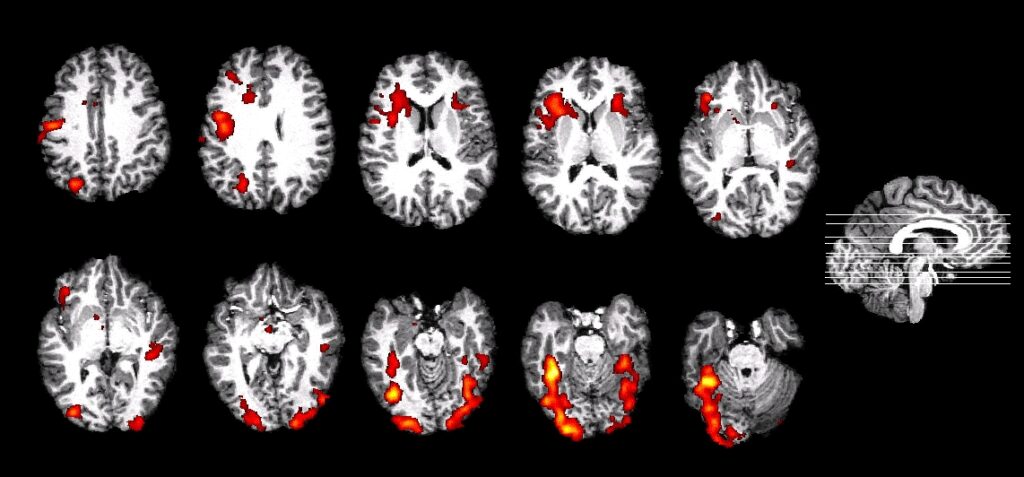
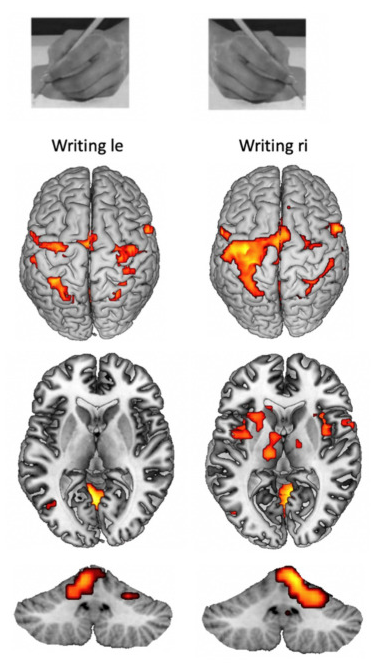
As with reading, writing activates the brain but on a broader basis. Results of fMRI show that writing activates multiple brain regions simultaneously, linking memory, attention, language, and motor coordination. As with reading, the patterns of activity when writing are predictable and measurable, but they appear in a larger number of segments of the brain.
Adapted from Lotze M. Performance control during longitudinal activation fMRI studies. Front Hum Neurosci. 2024 Oct 15;18:1459140. doi: 10.3389/fnhum.2024.1459140. PMID: 39474131; PMCID: PMC11521045. Image Copyright Creative Commons by Martin Lotze.
Neuroscience reveals the target for improving literacy!
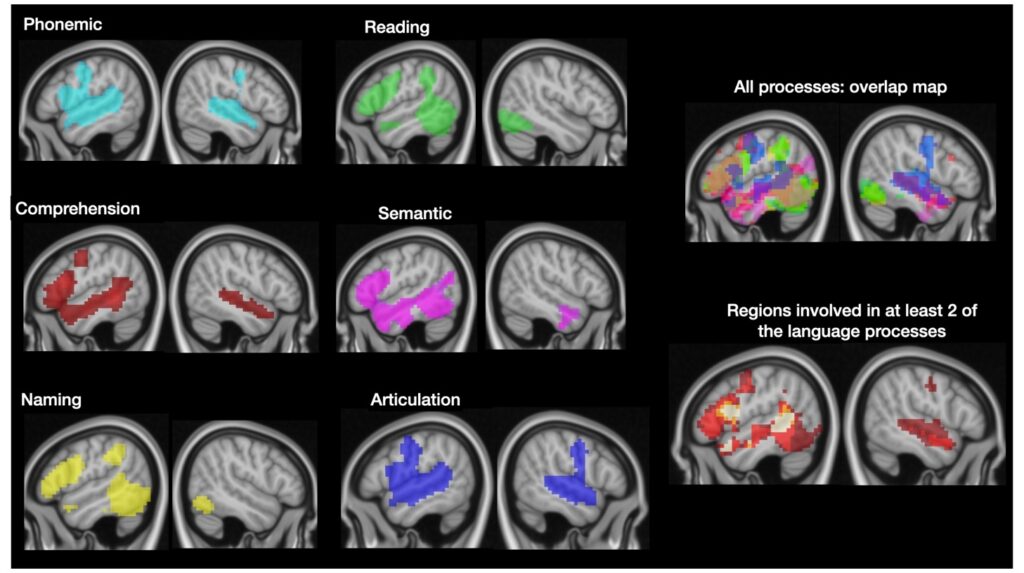
From meta-analysis of more than 13,500 studies, Voetz et al mapped brain activity and the pathways formed during various kinds of linguistic tasks. As shown, the brain utilizes a large number of regions to perform tasks that are crucial to linguistic literacy, such as understanding (comprehension), identifying (naming), and expressing (articulation). In fact, the brain is amazing in its ability to call upon already formed pathways while continually forming new ones!
This ability is called plasticity. It is the brain’s ability to change, reorganize, and form new neural connections throughout life. It is fundamental to learning.
Plasticity allows the brain to strengthen or or modify pathways based on experience. When we learn new information or skills (like reading, playing an instrument, or speaking a new language), our brains create new pathways or modify existing ones. This flexibility underlies all forms of learning and long-term memory.
These concepts are crucial to the development of critical thinking, the ability to call upon past learning, incorporate new learning, and explain the connections between them and the importance of the combined knowledge. Therefore, the development of learning strategies that promote active brain plasticity should be our target.
Neuroscience reveals the target for improving literacy!
From meta-analysis of more than 13,500 studies, Voetz et al mapped brain activity and the pathways formed during various kinds of linguistic tasks. As shown, the brain utilizes a large number of regions to perform tasks that are crucial to linguistic literacy, such as understanding (comprehension), identifying (naming), and expressing (articulation). In fact, the brain is amazing in its ability to call upon already formed pathways while continually forming new ones!
This ability is called plasticity. It is the brain’s ability to change, reorganize, and form new neural connections throughout life. It is fundamental to learning.
Plasticity allows the brain to strengthen or or modify pathways based on experience. When we learn new information or skills (like reading, playing an instrument, or speaking a new language), our brains create new pathways or modify existing ones. This flexibility underlies all forms of learning and long-term memory.
These concepts are crucial to the development of critical thinking, the ability to call upon past learning, incorporate new learning, and explain the connections between them and the importance of the combined knowledge. Therefore, the development of learning strategies that promote active brain plasticity should be our target.
The Literacy Rope Framework in the Science of Writing
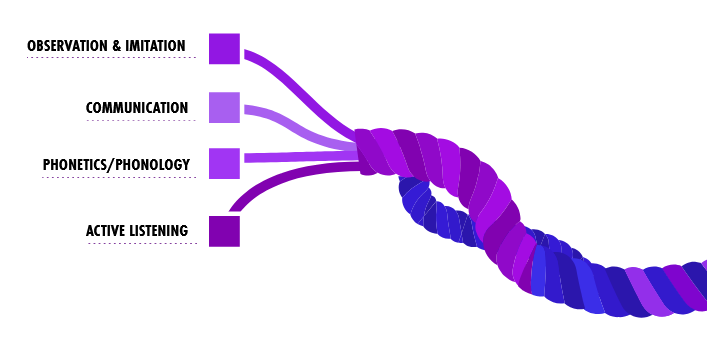
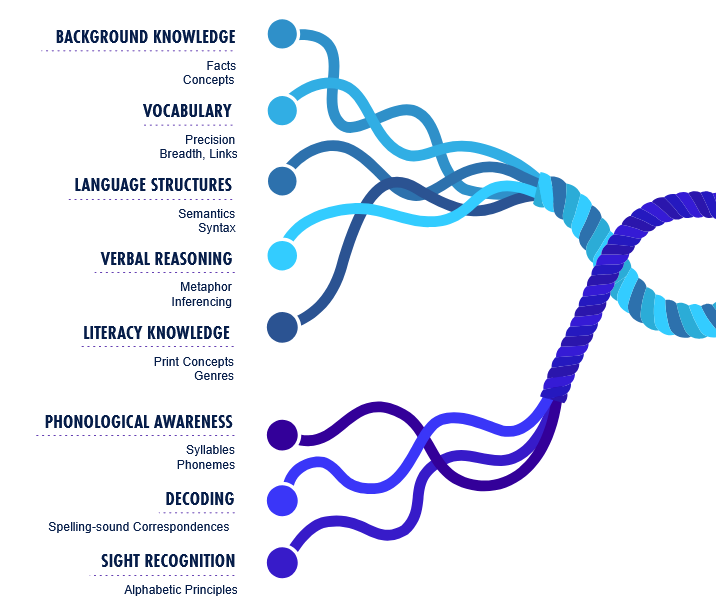
Noted researcher, psychologist, and literacy expert, Dr. Hollis Scarborough translated the findings regarding the brain’s role in learning to read from neuroscience to education. Scarborough characterized the elements and process of reading development with a graphic illustration of the skills and knowledge learners gain to become increasingly fluent readers.
As the Vantage Reading Rope illustrates, the three strands of Word Recognition are Phonological Awareness, Decoding, and Sight Recognition while the five strands of Language Comprehension are Background Knowledge, Vocabulary, Language Structures, Verbal Reasoning, and Literacy Knowledge. These eight strands become entwined with practice, and the strands of Word Recognition become increasingly automatic while the strands of Language Comprehension become increasingly strategic. The more tightly the strands entwine, the more fluent the reader!
The Final Framework in the Science of Writing: The Writing Carousel
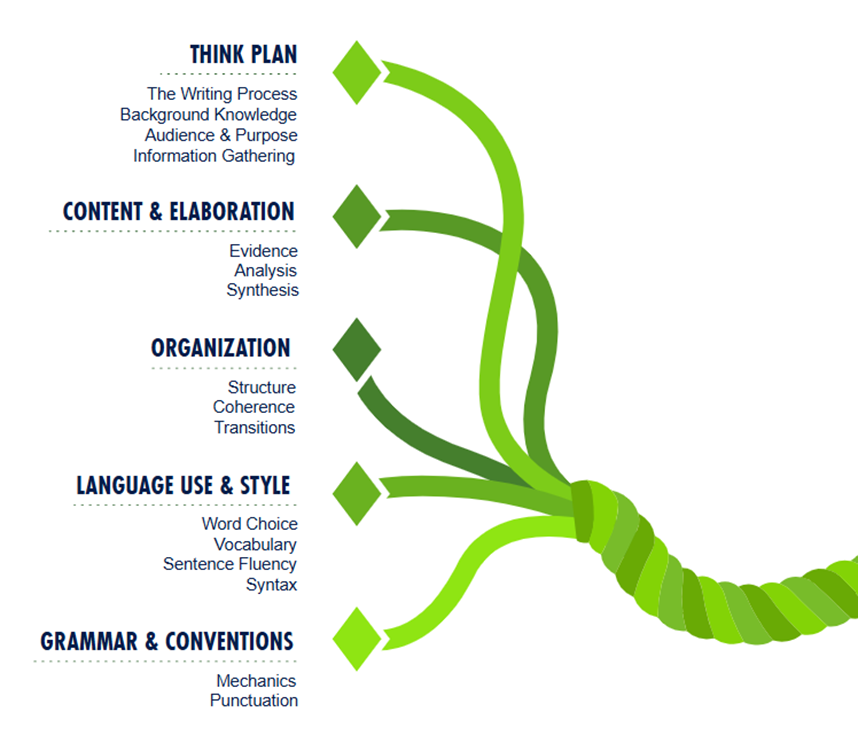
In the development of a fluent writer, the Writing Rope lays out the what of writing–the skills and knowledge one needs to write proficiently.
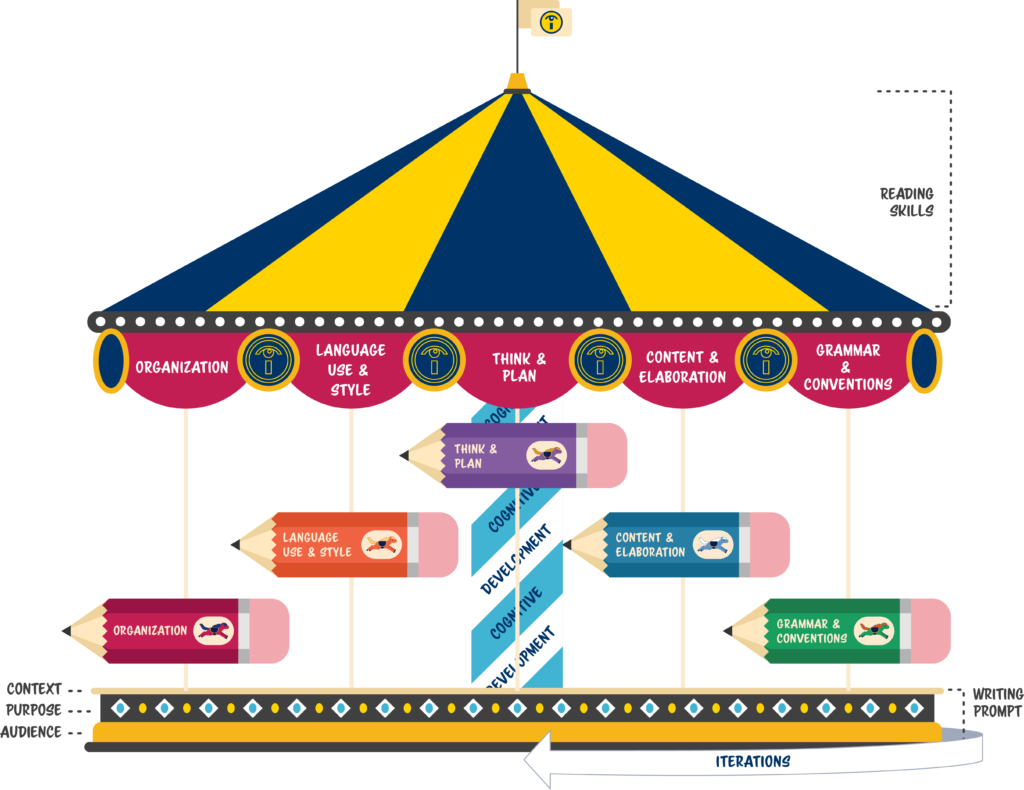
The Writing Carousel gives us a process, the how of writing.
Building on strands of The Writing Rope, the Writing Carousel is a graphic not just for the writing process but also for the development of knowledge and skills necessary for achieving writing fluency. In other words, it’s a process for creating effective expression and for developing fluent writers.
That process begins with a writing assignment, which is the foundation underlying the carousel. The elements of the platform are the questions a writer begins with:
- Who am I writing for?
- What am I writing about?
- Why am I writing (to describe, persuade, inform, or tell a story)?
The canopy of the carousel includes the reading skills and knowledge a writer possesses before tackling a writing task. Think of it as background knowledge about the topic and writing.
The carousel is in constant motion as writers go through the writing process–moving from pre-writing to drafting to revising to editing and proofreading in an iterative process.
Each station on the carousel aligns with a category of knowledge and skills writers are going to further develop as they engage in the writing process. These stations–Think/plan, Content & Elaboration, Organization, Language & Style, Grammar & Conventions–align with categories of development in the Writing Rope. At any given point in “the ride,” one station might be higher than others, a condition that’s realistic. After all, aspects of a communication, such as organization or language, are not perfectly balanced at every stage of revision.
The central pole around which the stations rotate is cognitive development–that is, reflection, self-regulation, and metacognition about reading AND writing.

Evidence-based Teaching and Learning Strategies Supporting the Writing Carousel
When analyzing what students need and the conditions that exist when students aren’t getting all they need, Graham (2019) found that teachers wanted to feel confident about teaching writing and that effective writing instruction involves:
- “Writing frequently for real and different purposes,
- Supporting students as they write,
- Teaching the needed writing skills, knowledge, and processes,
- Creating a supportive and motivating writing environment; and
- Connecting writing, reading, and learning.” (2019)
Graham concludes that professional learning focused on employing writing strategies with high effect sizes (Hattie) helps teachers feel confident that they’re teaching effectively.
Graham, S. (2019). Review of Research in Education, Vol. 43, Issue 1, pp.277-303